侍 are without a doubt one of Japan's best known historical figures; the image of the proud warrior standing strong to his last breath is inseparable from almost any part of the nation's ancient history and culture. Like 忍者 (にんじゃ - ninja) though, it doesn't take long before the history ends and the fantasy begins. Let's try to keep the demons and magic swords to a minimum - the stories and legacies of some of Japan's most famous 侍 are amazing enough as they are.
Showing posts with label pop culture. Show all posts
Showing posts with label pop culture. Show all posts
Thursday, December 15, 2011

Friday, November 4, 2011
Places to visit in Hyogo 8: 宝塚 (たからづか - Takarazuka)
宝塚 is a suburban city located a short distance north of 神戸 (こうべ - Kobe) and 大阪 (おおさか - Osaka), on the eastern side of Hyogo. Its name, amusingly, means "treasure pile" and there are certainly shiny trinkets to be found there, thanks in part to a politician and businessman determined to make 宝塚 more than a sleepy commuter town. After several attempts, he finally struck gold with the creation of a musical theatre group now known as the 宝塚歌劇団 (たからづかかげきだん - takarazuka kagekidan - "Takarazuka Revue"). As a counterpoint to 歌舞伎 (かぶき - Kabuki), the 歌劇団 features an all-female cast and its flashy shows are still the city's most famous drawcard after nearly 100 years. I think that's our cue.
Thursday, October 6, 2011
ゲームセンター (geemu sentaa) - Game centres
You don't have to go far to realise gaming is a big part of the melting pot of Japanese pop culture - it's where a lot of アニメ (anime), music and soon-to-be national obsessions cut their teeth. ゲームセンター or what we might call "arcades" may have a limited appeal at home but here they're for people of all ages. Some come for the cuteness, some are after more collectibles to hoard and others just have a high score or boss to beat. From prize games to sticker photos to things that can't even be categorised, there's something for everyone here - let's get ourselves some change and join the fun.
Thursday, April 21, 2011
忍者 (にんじゃ) - Ninja
忍者, or 忍び (しのび - shinobi) as they are sometimes known, hardly need any introduction - they would have to be among the strongest associations people have with Japan. It's easy to see why - for as long as there's been a medium for them, these shadowy figures have been prowling our screens, books, comics, video games and imaginations. They can be faceless assassins, figures of fun or anti-heroes standing alone in the face of corruption. Invariably they're skilled fighters, but sometimes they border on being full-blown superheroes or magicians as well. The question is how much of 忍者 folklore is true and how much is pure fantasy; it might be the facts that surprise you most of all.
Friday, October 29, 2010
Halloween post - お化け (おばけ - obake - Monsters/ghosts)
Halloween (ハロウィーン) is nearly upon us, which in Japan is as much of a big deal as it is in Australia (or perhaps even less). Like Valentine's Day, it's mostly a curiosity turned commercial holiday. Decorations and costumes have appeared in shops and jack-o'-lanterns and "trick or treat" signs have sprung up here and there, but apart from that it's all a bit of a non-issue. Don't think that means Japan doesn't have its fair share of scares, mind you - there's plenty of ghosts, demons and monsters to go around, ハロウィーン or no. So in the spirit of the scary season, let's find out what goes bump in Japan's night.
Friday, September 24, 2010
東京 (とうきょう) - Tokyo
Big brother to 大阪 (おおさか - Osaka) and perhaps one of the most recognisable elements of Japan, 東京 sits unapologetically on its throne as Japan's capital and largest city. The metropolitan part of 東京 is a self-named prefecture in itself, but the greater 東京 area straddles three other prefectures and is home to more than 35 million people; on average, about 2500 of them are packed in per square kilometre.
If you're anything like me, the first two things that will come into your mind when you arrive in 東京 will be "people" and "buildings". Let me show you why.
If you're anything like me, the first two things that will come into your mind when you arrive in 東京 will be "people" and "buildings". Let me show you why.
Friday, August 20, 2010
大阪 (おおさか) - Osaka
大阪 is the biggest city in the 関西 (かんさい - Kansai) area and only eclipsed by 東京 (とうきょう - Tokyo) and 横浜 (よこはま - Yokohama) nationwide. In some ways 大阪 feels worlds away from 神戸 (こうべ - Kobe) despite being so close; it's like the Sydney to its Melbourne. Where 神戸 has a smaller, closer atmosphere to it, 大阪 is very much a big city in every way.
I'll let you decide whether that's a good or a bad thing.
Thursday, July 8, 2010
Japaneats その4 - ファーストフード (Fast food)
Let's face it - there will be gloomy days during 梅雨 (つゆ - tsuyu - the rainy season) when you just want to veg out and eat junk food. Fortunately, you can kill your ハンバーガー (hamburger) cravings in true Japanese style. Whether it's a burger place you won't find at home or an imported chain, let's have a look at what's on offer. Loosen your belt, grab some napkins and pull up a plastic stool for today's Japaneats.
Thursday, July 1, 2010
オタクの世界 (おたくのせかい - otaku no sekai) - The world of "otaku"
There seems to be some disagreement about what "オタク" actually are but for the sake of brevity, let's just call them "nerds", "geeks" and as some people on the internet call them, "fanboys/fangirls". Essentially, they're people with an obsession; their lives seemingly revolve around something that isn't nearly as important to other people. This is commonly referred to in Japan as a マニア (mania), which is why オタク are sometimes called マニアック (maniacs). Given that this is the land of アニメ (anime), マンガ (manga) and テレビゲーム (terebi geemu - video games) these are the most common マニア which I'll be focusing on today, but there are others. One of my coworkers is a self-confessed 電車オタク (でんしゃおたく - densha otaku - "train geek") and I'm told this isn't uncommon! Next stop, オタクの世界.
The word オタク started out as derogatory - it had the same connotations as "loser" or "freak", but that's started to change. Some people now wear it as a badge of honour, but it can still cause offence for those who don't. The modern オタク community has properly found its feet on the internet with Japanese image and chat boards such as 2channel (pronounced "二チャンネル" - ni channeru). Forums like this offer オタク the chance to post anonymously on thousands of different topics; most Japanese internet slang, jokes and pop culture come from boards like 2channel. Sometimes they even blossom into full-blown cultural phenomena. Probably the most famous example of this was an incident known as 電車男 (でんしゃおとこ - densha otoko - train man). It involved a romantically clumsy オタク who spent several months getting advice from posters about how he could win over a girl he met on the train one day. True or not, it ended up being made into several マンガ series and even turned into a soap opera! This is definitely worth Googling.
Not all オタク are shrinking violets, mind you - there are many public events and conventions that cater to their hunger for collectibles and spending time with like-minded people. These are sometimes known as オタコン ("otacon"), which is a Japanese shortening of the words "オタク" and "convention". At these, オタク are able to buy マンガ, フィギュア ("figyua" - figurines of popular characters), prints based on their favourite series and almost any other merchandise you can imagine. If it exists, someone collects it.
Perhaps the most interesting part of オタコン and other events is the コスプレ ("cosplay"). This is another Japanese shortening of "costume" and "play", basically meaning fancy dress. Given the dedication of some people to their art, the results can be amazing, as I found out when I visited this year's "Osaka Street Festa".

This might not be quite what you imagine when you think of reserved, measured Japan! The surging crowds spoke for themselves, though - hundreds of オタク dressed in specially made costumes, wigs and all. When the hair was too impractical to be real, they just made it themselves!

The Yu-Gi-Oh, Pokemon and Dragonball fans were out in force and for every one cosplayer there were ten people there to take photos.

Some of the cosplayers themselves even had the cameras out - these One Piece fans in particular didn't want to let the opportunity for some good photos get away.

Not everyone was dressed up as modern characters of course, like this cosplayer dressed as 食い倒れ太郎 (くいだおれたろう - kuidaore tarou). He's an old clown-like drummer puppet that stands outside a restaurant in Osaka, who's become a bit of a symbol of the city. His name roughly translates to "eat until you collapse Tarou", which must be something Osaka is renowned for!

In what would have to be the strangest part of the event, the cleaners then showed up in full costume. I think it's the only time I'll ever see people in samurai costumes picking up rubbish on the street! Welcome to オタクの世界, where even the cleaners enjoy a little コスプレ. I find it amazing that such a large community has sprung up from what must have been humble roots - such is the power of the internet and two-speed Japanese culture. オタク rejoice, and rest assured that whatever kind of マニア you have, there'll be plenty of other マニアック you can share it with. They might even help you make your costume.
The word オタク started out as derogatory - it had the same connotations as "loser" or "freak", but that's started to change. Some people now wear it as a badge of honour, but it can still cause offence for those who don't. The modern オタク community has properly found its feet on the internet with Japanese image and chat boards such as 2channel (pronounced "二チャンネル" - ni channeru). Forums like this offer オタク the chance to post anonymously on thousands of different topics; most Japanese internet slang, jokes and pop culture come from boards like 2channel. Sometimes they even blossom into full-blown cultural phenomena. Probably the most famous example of this was an incident known as 電車男 (でんしゃおとこ - densha otoko - train man). It involved a romantically clumsy オタク who spent several months getting advice from posters about how he could win over a girl he met on the train one day. True or not, it ended up being made into several マンガ series and even turned into a soap opera! This is definitely worth Googling.
Not all オタク are shrinking violets, mind you - there are many public events and conventions that cater to their hunger for collectibles and spending time with like-minded people. These are sometimes known as オタコン ("otacon"), which is a Japanese shortening of the words "オタク" and "convention". At these, オタク are able to buy マンガ, フィギュア ("figyua" - figurines of popular characters), prints based on their favourite series and almost any other merchandise you can imagine. If it exists, someone collects it.
Perhaps the most interesting part of オタコン and other events is the コスプレ ("cosplay"). This is another Japanese shortening of "costume" and "play", basically meaning fancy dress. Given the dedication of some people to their art, the results can be amazing, as I found out when I visited this year's "Osaka Street Festa".
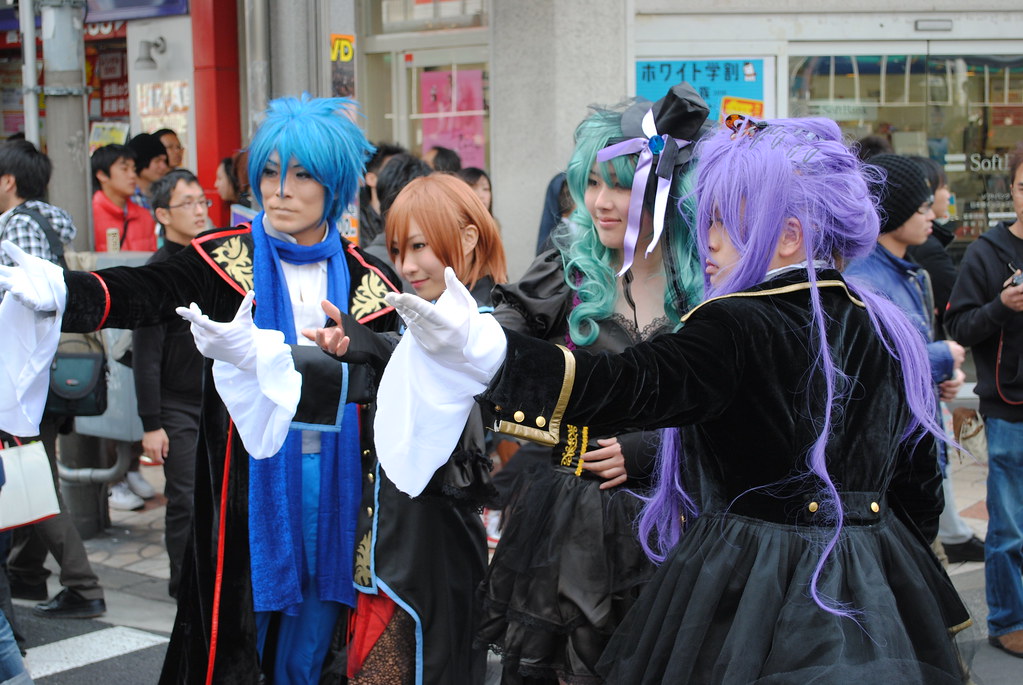
This might not be quite what you imagine when you think of reserved, measured Japan! The surging crowds spoke for themselves, though - hundreds of オタク dressed in specially made costumes, wigs and all. When the hair was too impractical to be real, they just made it themselves!
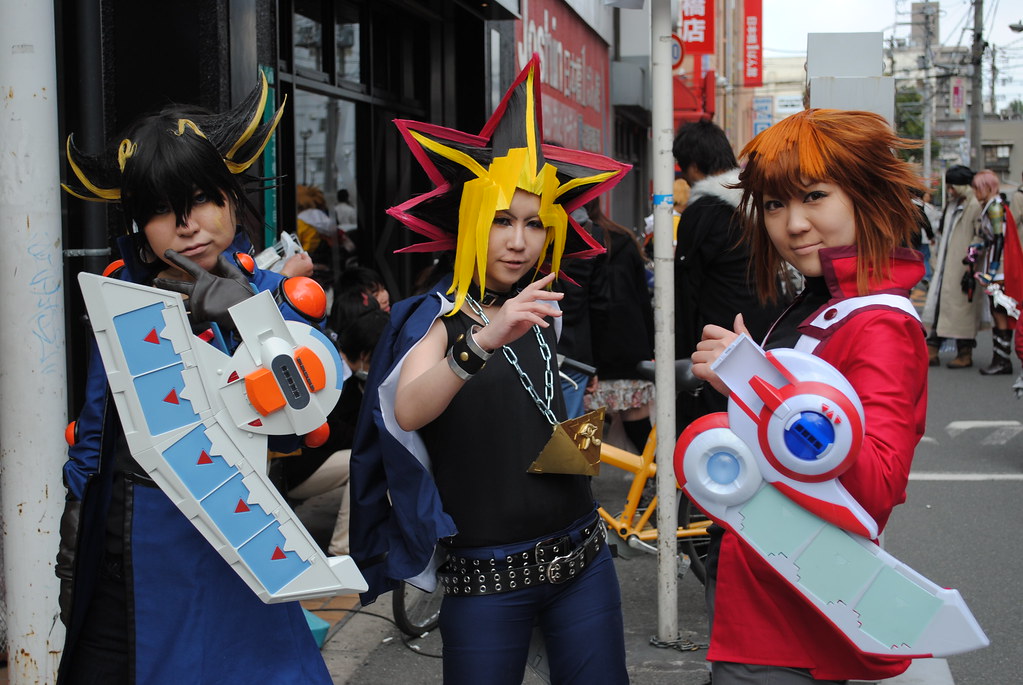
The Yu-Gi-Oh, Pokemon and Dragonball fans were out in force and for every one cosplayer there were ten people there to take photos.
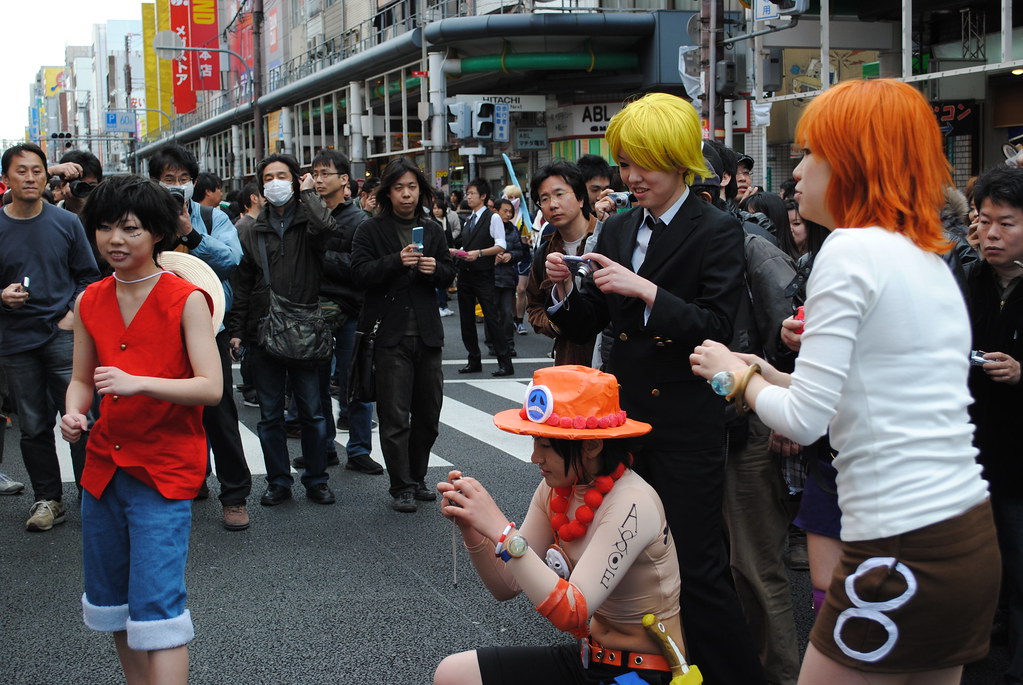
Some of the cosplayers themselves even had the cameras out - these One Piece fans in particular didn't want to let the opportunity for some good photos get away.
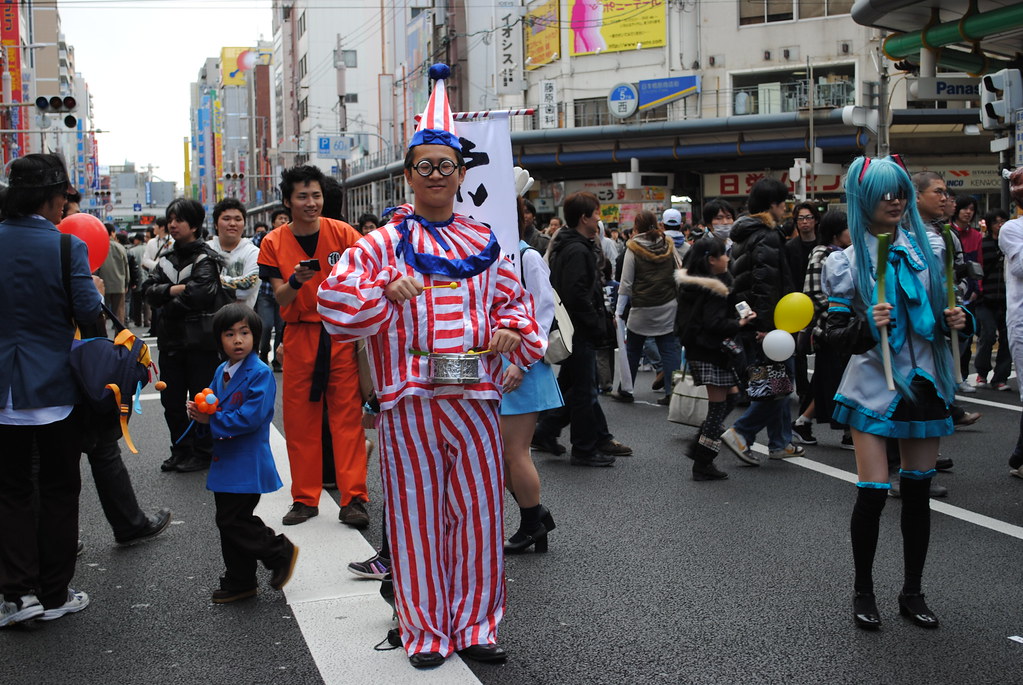
Not everyone was dressed up as modern characters of course, like this cosplayer dressed as 食い倒れ太郎 (くいだおれたろう - kuidaore tarou). He's an old clown-like drummer puppet that stands outside a restaurant in Osaka, who's become a bit of a symbol of the city. His name roughly translates to "eat until you collapse Tarou", which must be something Osaka is renowned for!
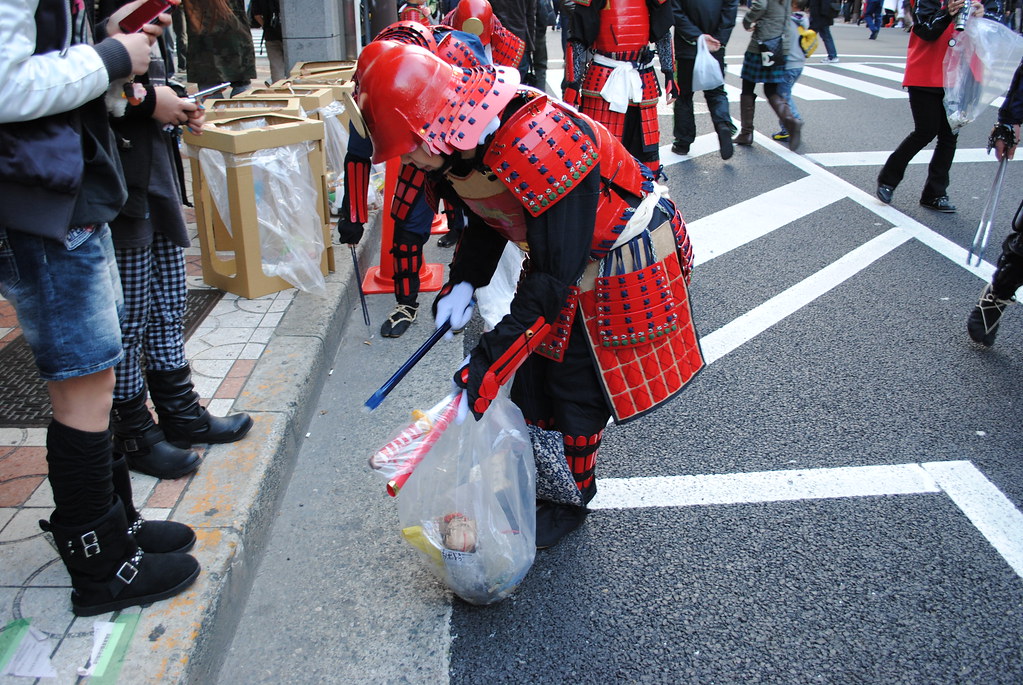
In what would have to be the strangest part of the event, the cleaners then showed up in full costume. I think it's the only time I'll ever see people in samurai costumes picking up rubbish on the street! Welcome to オタクの世界, where even the cleaners enjoy a little コスプレ. I find it amazing that such a large community has sprung up from what must have been humble roots - such is the power of the internet and two-speed Japanese culture. オタク rejoice, and rest assured that whatever kind of マニア you have, there'll be plenty of other マニアック you can share it with. They might even help you make your costume.
Friday, June 11, 2010
~放題 (~ほうだい - ~houdai) - As much as you like!
Reaching into Japan's bag of surprises today produces a little piece of paper that says "放題". It's added to a verb (or occasionally a noun), making the meaning "all you can X" or "X as much as you like". I'm sure most people would think of Japan as a conservative culture; most of what you see is small, delicate servings of food and minimalistic traditions. More and more though, a buffet culture of "放題" seems to be catching on and becoming another facet of the Dr Jekyll and Mr Hyde nature of Japan. The next time you see a picture of a pretty girl in a 着物 (きもの - kimono) eating 寿司 (すし - sushi), bear in mind that it might be her 26th plate.
Tuesday, March 16, 2010
バレンタインデーとホワイトデー (barentain de- to howaito de-) Valentine's Day and White Day
Sunday was ホワイトデー in Japan, which is a very similar followup to バレンタインデー that takes place one month later on March 14th. Why do they need two separate days? The answer is fairly simple, if a little strange.
Wednesday, February 24, 2010
Japaneats その1 - きつねうどん and たぬきそば (Kitsune udon and Tanuki soba)
"Japaneats" will be a series of posts about things that you must eat if you come to Japan - I'm going to make it a rule!
Today's Japaneats are きつねうどん and たぬきそば. Udon are thick white noodles made of wheat flour, usually served in soup. Soba are thinner, darker coloured buckwheat noodles which are possibly a bit closer to what we're used to at home. "Kitsune" means "fox" and the "tanuki" is a Japanese animal like a raccoon or a badger (officially translated as a "raccoon dog"). Thankfully neither of them are actually in their dish!
Today's Japaneats are きつねうどん and たぬきそば. Udon are thick white noodles made of wheat flour, usually served in soup. Soba are thinner, darker coloured buckwheat noodles which are possibly a bit closer to what we're used to at home. "Kitsune" means "fox" and the "tanuki" is a Japanese animal like a raccoon or a badger (officially translated as a "raccoon dog"). Thankfully neither of them are actually in their dish!
Subscribe to:
Posts (Atom)