冬 (ふゆ - fuyu - Winter) is the first and last season of the Japanese year, its icy fingers officially taking hold in December and refusing to loosen until the start of 春 (はる - haru - Spring) in early April. Like 夏 (なつ - natsu - Summer), 冬 takes up more than its fair share of the year and it's just as uncomfortable, particularly for people used to living south of the Equator. Having said that, it can be extraordinarily beautiful, it plays host to one of the most spectacular festivals of the year and best of all, noone will notice your クリスマス (Christmas) kilos under that big coat. Grab your scarf and gloves, because it's cold out there.
Showing posts with label language. Show all posts
Showing posts with label language. Show all posts
Friday, February 25, 2011

Thursday, July 1, 2010
オタクの世界 (おたくのせかい - otaku no sekai) - The world of "otaku"
There seems to be some disagreement about what "オタク" actually are but for the sake of brevity, let's just call them "nerds", "geeks" and as some people on the internet call them, "fanboys/fangirls". Essentially, they're people with an obsession; their lives seemingly revolve around something that isn't nearly as important to other people. This is commonly referred to in Japan as a マニア (mania), which is why オタク are sometimes called マニアック (maniacs). Given that this is the land of アニメ (anime), マンガ (manga) and テレビゲーム (terebi geemu - video games) these are the most common マニア which I'll be focusing on today, but there are others. One of my coworkers is a self-confessed 電車オタク (でんしゃおたく - densha otaku - "train geek") and I'm told this isn't uncommon! Next stop, オタクの世界.
The word オタク started out as derogatory - it had the same connotations as "loser" or "freak", but that's started to change. Some people now wear it as a badge of honour, but it can still cause offence for those who don't. The modern オタク community has properly found its feet on the internet with Japanese image and chat boards such as 2channel (pronounced "二チャンネル" - ni channeru). Forums like this offer オタク the chance to post anonymously on thousands of different topics; most Japanese internet slang, jokes and pop culture come from boards like 2channel. Sometimes they even blossom into full-blown cultural phenomena. Probably the most famous example of this was an incident known as 電車男 (でんしゃおとこ - densha otoko - train man). It involved a romantically clumsy オタク who spent several months getting advice from posters about how he could win over a girl he met on the train one day. True or not, it ended up being made into several マンガ series and even turned into a soap opera! This is definitely worth Googling.
Not all オタク are shrinking violets, mind you - there are many public events and conventions that cater to their hunger for collectibles and spending time with like-minded people. These are sometimes known as オタコン ("otacon"), which is a Japanese shortening of the words "オタク" and "convention". At these, オタク are able to buy マンガ, フィギュア ("figyua" - figurines of popular characters), prints based on their favourite series and almost any other merchandise you can imagine. If it exists, someone collects it.
Perhaps the most interesting part of オタコン and other events is the コスプレ ("cosplay"). This is another Japanese shortening of "costume" and "play", basically meaning fancy dress. Given the dedication of some people to their art, the results can be amazing, as I found out when I visited this year's "Osaka Street Festa".

This might not be quite what you imagine when you think of reserved, measured Japan! The surging crowds spoke for themselves, though - hundreds of オタク dressed in specially made costumes, wigs and all. When the hair was too impractical to be real, they just made it themselves!

The Yu-Gi-Oh, Pokemon and Dragonball fans were out in force and for every one cosplayer there were ten people there to take photos.

Some of the cosplayers themselves even had the cameras out - these One Piece fans in particular didn't want to let the opportunity for some good photos get away.

Not everyone was dressed up as modern characters of course, like this cosplayer dressed as 食い倒れ太郎 (くいだおれたろう - kuidaore tarou). He's an old clown-like drummer puppet that stands outside a restaurant in Osaka, who's become a bit of a symbol of the city. His name roughly translates to "eat until you collapse Tarou", which must be something Osaka is renowned for!

In what would have to be the strangest part of the event, the cleaners then showed up in full costume. I think it's the only time I'll ever see people in samurai costumes picking up rubbish on the street! Welcome to オタクの世界, where even the cleaners enjoy a little コスプレ. I find it amazing that such a large community has sprung up from what must have been humble roots - such is the power of the internet and two-speed Japanese culture. オタク rejoice, and rest assured that whatever kind of マニア you have, there'll be plenty of other マニアック you can share it with. They might even help you make your costume.
The word オタク started out as derogatory - it had the same connotations as "loser" or "freak", but that's started to change. Some people now wear it as a badge of honour, but it can still cause offence for those who don't. The modern オタク community has properly found its feet on the internet with Japanese image and chat boards such as 2channel (pronounced "二チャンネル" - ni channeru). Forums like this offer オタク the chance to post anonymously on thousands of different topics; most Japanese internet slang, jokes and pop culture come from boards like 2channel. Sometimes they even blossom into full-blown cultural phenomena. Probably the most famous example of this was an incident known as 電車男 (でんしゃおとこ - densha otoko - train man). It involved a romantically clumsy オタク who spent several months getting advice from posters about how he could win over a girl he met on the train one day. True or not, it ended up being made into several マンガ series and even turned into a soap opera! This is definitely worth Googling.
Not all オタク are shrinking violets, mind you - there are many public events and conventions that cater to their hunger for collectibles and spending time with like-minded people. These are sometimes known as オタコン ("otacon"), which is a Japanese shortening of the words "オタク" and "convention". At these, オタク are able to buy マンガ, フィギュア ("figyua" - figurines of popular characters), prints based on their favourite series and almost any other merchandise you can imagine. If it exists, someone collects it.
Perhaps the most interesting part of オタコン and other events is the コスプレ ("cosplay"). This is another Japanese shortening of "costume" and "play", basically meaning fancy dress. Given the dedication of some people to their art, the results can be amazing, as I found out when I visited this year's "Osaka Street Festa".
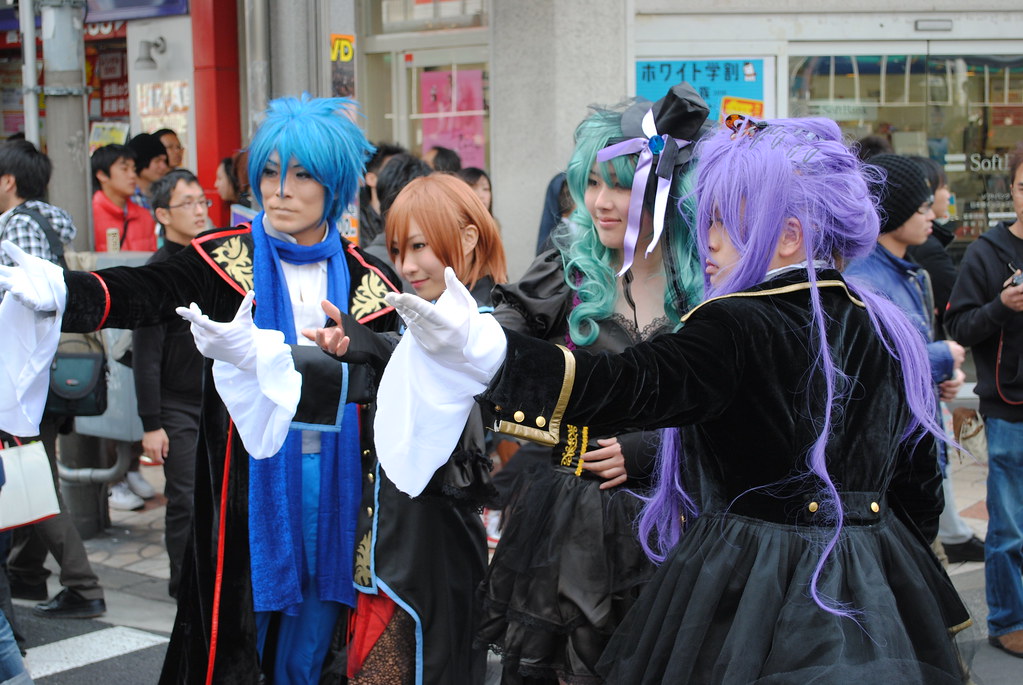
This might not be quite what you imagine when you think of reserved, measured Japan! The surging crowds spoke for themselves, though - hundreds of オタク dressed in specially made costumes, wigs and all. When the hair was too impractical to be real, they just made it themselves!
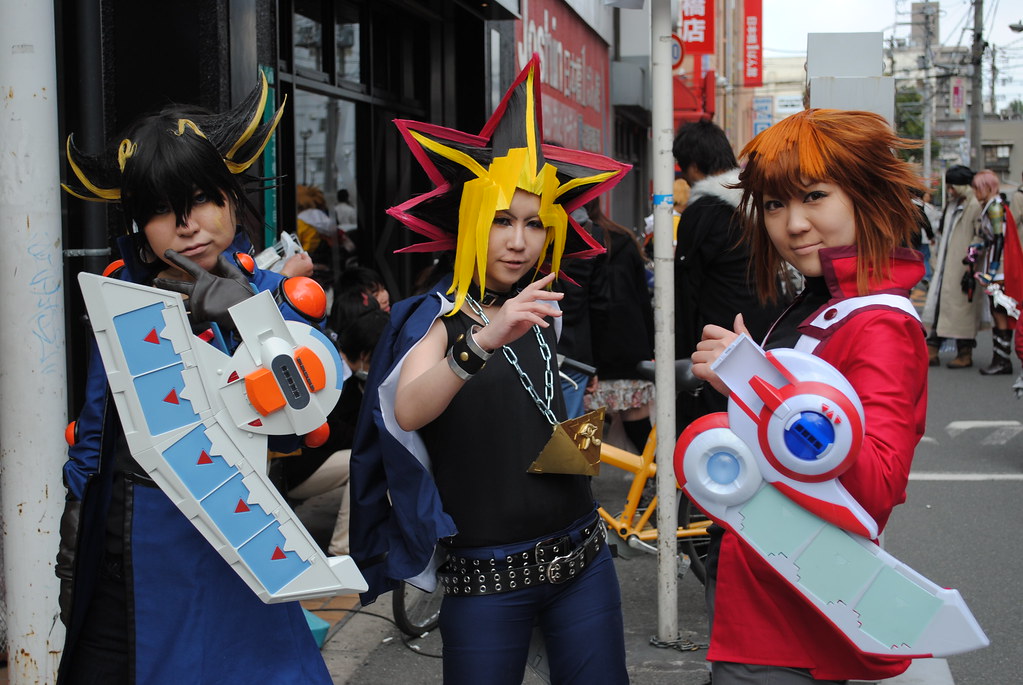
The Yu-Gi-Oh, Pokemon and Dragonball fans were out in force and for every one cosplayer there were ten people there to take photos.
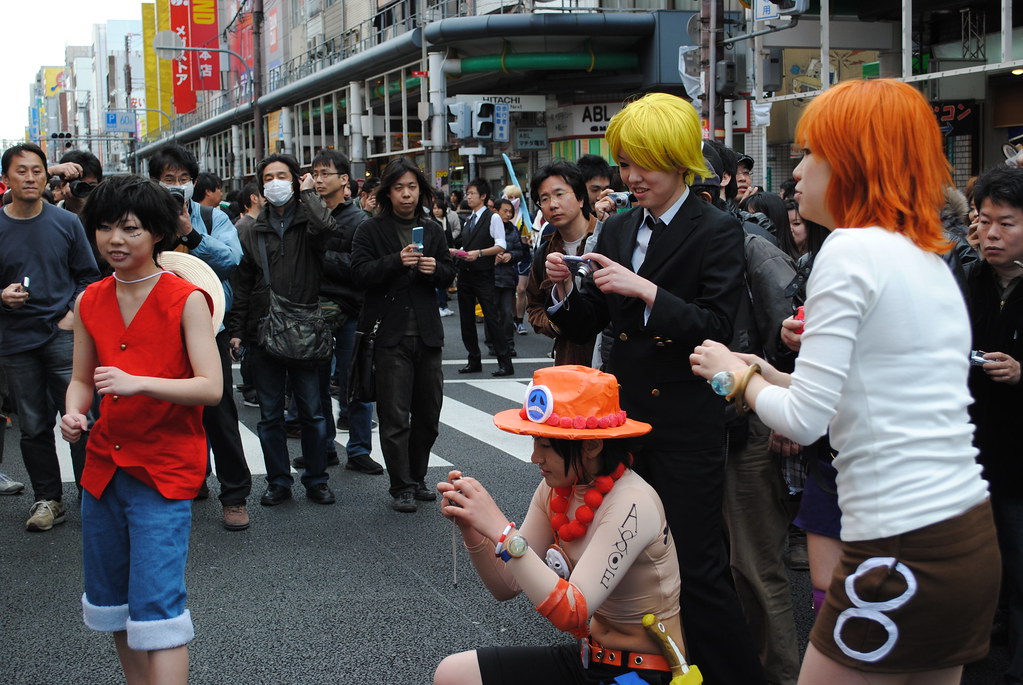
Some of the cosplayers themselves even had the cameras out - these One Piece fans in particular didn't want to let the opportunity for some good photos get away.
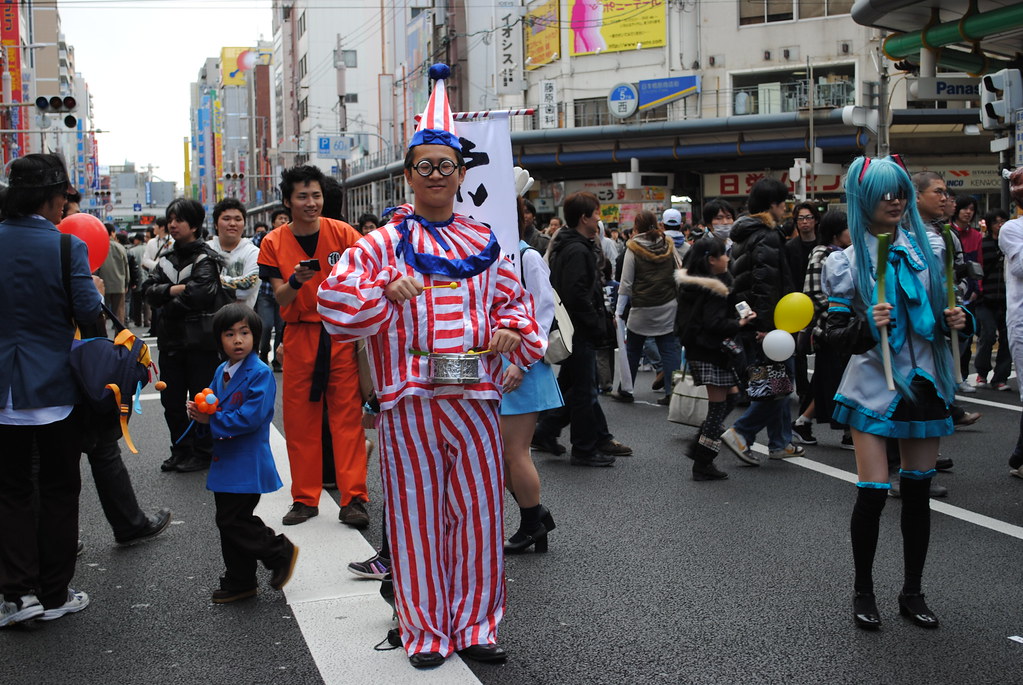
Not everyone was dressed up as modern characters of course, like this cosplayer dressed as 食い倒れ太郎 (くいだおれたろう - kuidaore tarou). He's an old clown-like drummer puppet that stands outside a restaurant in Osaka, who's become a bit of a symbol of the city. His name roughly translates to "eat until you collapse Tarou", which must be something Osaka is renowned for!
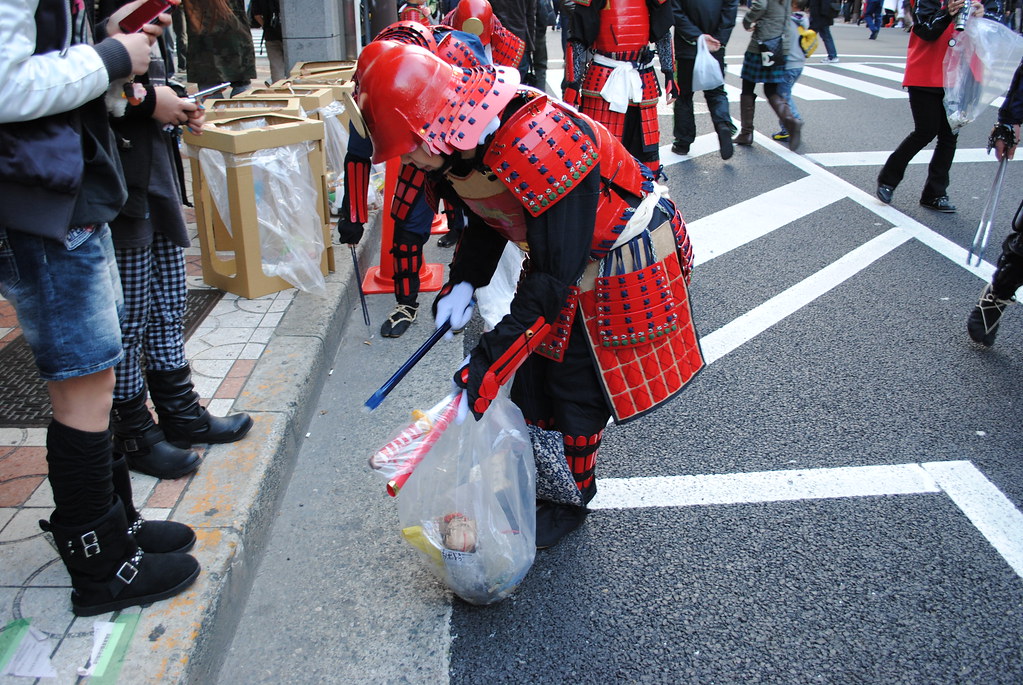
In what would have to be the strangest part of the event, the cleaners then showed up in full costume. I think it's the only time I'll ever see people in samurai costumes picking up rubbish on the street! Welcome to オタクの世界, where even the cleaners enjoy a little コスプレ. I find it amazing that such a large community has sprung up from what must have been humble roots - such is the power of the internet and two-speed Japanese culture. オタク rejoice, and rest assured that whatever kind of マニア you have, there'll be plenty of other マニアック you can share it with. They might even help you make your costume.
Friday, June 18, 2010
お金と銀行 (おかねとぎんこう - okane to ginkou) - Money and Banks
I hardly use cash in Australia, I'll admit - aside from small purchases, I tend to just pull out my credit card or pay on EFTPOS. In Japan, bank cards are strictly for withdrawing money and credit cards are generally reserved for big purchases at international chains and major department stores. As they keep telling me here, cash is king. I've witnessed people withdrawing what must be thousands of dollars at a time; even I find myself panicking now if my wallet is down to its last $100. They say money talks, so let's see what the 円 (えん - en - yen) has to say for itself.
Friday, June 11, 2010
~放題 (~ほうだい - ~houdai) - As much as you like!
Reaching into Japan's bag of surprises today produces a little piece of paper that says "放題". It's added to a verb (or occasionally a noun), making the meaning "all you can X" or "X as much as you like". I'm sure most people would think of Japan as a conservative culture; most of what you see is small, delicate servings of food and minimalistic traditions. More and more though, a buffet culture of "放題" seems to be catching on and becoming another facet of the Dr Jekyll and Mr Hyde nature of Japan. The next time you see a picture of a pretty girl in a 着物 (きもの - kimono) eating 寿司 (すし - sushi), bear in mind that it might be her 26th plate.
Friday, May 14, 2010
ゴールデンウィーク (Golden Week)
ゴールデンウィーク (often shortened to the letters "GW" in Japan) is arguably the biggest holiday season in Japan, along with お盆 (おぼん - Obon) in mid-August and シルバーウィーク (Silver Week) in mid-late September. GW is basically a string of public holidays spanning from late April to early May that usually mean at least five days off work. It's the perfect excuse for Japan to pack her bags and go just about everywhere else you can imagine for a well-earned break. The only problem with travelling during GW is that everyone else has the same idea!
Friday, April 9, 2010
開? 閉? Everything that opens and shuts
Another little rule of thumb to help those as scatterbrained with 漢字 (かんじ - kanji) as I am.
開ける (あける - akeru - open) and 閉める (しめる - shimeru - close) are easy enough to remember if you have the ひらがな (hiragana) clues, but a lot of the time they'll only be written as 開 and 閉. I often forget which is which, so I came up with a trick a while ago.
I reckon the bit in the middle of "開" looks a bit like a capital A - A for "akeru". Remember this, and never accidentally slam an elevator door in someone's face again!
Have your own rules and rhymes for remembering things? Comment away - I'd love to hear them.
開ける (あける - akeru - open) and 閉める (しめる - shimeru - close) are easy enough to remember if you have the ひらがな (hiragana) clues, but a lot of the time they'll only be written as 開 and 閉. I often forget which is which, so I came up with a trick a while ago.
I reckon the bit in the middle of "開" looks a bit like a capital A - A for "akeru". Remember this, and never accidentally slam an elevator door in someone's face again!
Have your own rules and rhymes for remembering things? Comment away - I'd love to hear them.
Thursday, April 1, 2010
日本の四つの季節その1:春 (にほんのよつのきせつそのいち:はる) - The Four Seasons of Japan 1: Spring
One of the first questions I was asked when I came to Japan was "how many seasons are there in Australia?". You would be surprised how often this comes up. A lot of people seemed shocked or sceptical when I replied that we have four as well. I think the word their question is missing is "distinct" - we have names for each season, but how different are they in real terms? Once you spend a decent amount of time in Japan and compare it to Australia, you do have to admit that the difference between each season is much starker here. Or you could just read this series and I'll do my best to illustrate it for you.
On a language note, "the four seasons" can be formally written as 春夏秋冬 (しゅんかしゅうとう - shunkashuutou). It's just the kanji for spring, summer, autumn and winter stuck together which I think is very sensible. One of the teachers who sits next to me says that if you can use this when speaking to a Japanese person, they'll think you're "very cool".
On a language note, "the four seasons" can be formally written as 春夏秋冬 (しゅんかしゅうとう - shunkashuutou). It's just the kanji for spring, summer, autumn and winter stuck together which I think is very sensible. One of the teachers who sits next to me says that if you can use this when speaking to a Japanese person, they'll think you're "very cool".
Tuesday, March 16, 2010
バレンタインデーとホワイトデー (barentain de- to howaito de-) Valentine's Day and White Day
Sunday was ホワイトデー in Japan, which is a very similar followup to バレンタインデー that takes place one month later on March 14th. Why do they need two separate days? The answer is fairly simple, if a little strange.
Saturday, March 13, 2010
Mind your Ys and Ws
A couple of interesting Japanese abbrieviations I've noticed:
ワイシャツ (waishatsu - white collared shirt) is often written as Yシャツ.
W is often interpreted as "ダブル" (daburu - double), so you'll often see things like Wチーズバーガー (chi-zu ba-ga-), meaning "double cheeseburger".
Now if you'll excuse me, I'm off to drop my Yシャツ at the drycleaner and pick up a Wチーズピザ (chi-zu piza - cheese pizza) for dinner.
ワイシャツ (waishatsu - white collared shirt) is often written as Yシャツ.
W is often interpreted as "ダブル" (daburu - double), so you'll often see things like Wチーズバーガー (chi-zu ba-ga-), meaning "double cheeseburger".
Now if you'll excuse me, I'm off to drop my Yシャツ at the drycleaner and pick up a Wチーズピザ (chi-zu piza - cheese pizza) for dinner.
Monday, March 1, 2010
自動販売機 (じどうはんばいき - jidouhanbaiki) - Vending machines
自動販売機 (or sometimes just 販売機 - はんばいき - hanbaiki) literally means "automatic selling machine" and will probably be one of the longest Japanese words you learn. They've become a bit of a symbol of Japan and if you come to visit, you'll see why. You'll notice that there are a lot of them to say the least - the most of any country in the world, in fact. There's apparently one vending machine for every 23 people here (and the population is about 130 million). It's rumoured that they even have them on top of 富士山 (Fujisan - Mount Fuji)!
Let's have a closer look at a couple of our 5.5 million friends and see why they're so popular.
Let's have a closer look at a couple of our 5.5 million friends and see why they're so popular.
Wednesday, February 17, 2010
Worried about your exams? Try an octopus or a Kit Kat!
A couple of little Japanese plays on words for those of you who are a bit superstitious.
Subscribe to:
Posts (Atom)