You don't have to go far to realise gaming is a big part of the melting pot of Japanese pop culture - it's where a lot of アニメ (anime), music and soon-to-be national obsessions cut their teeth. ゲームセンター or what we might call "arcades" may have a limited appeal at home but here they're for people of all ages. Some come for the cuteness, some are after more collectibles to hoard and others just have a high score or boss to beat. From prize games to sticker photos to things that can't even be categorised, there's something for everyone here - let's get ourselves some change and join the fun.
Showing posts with label quirky. Show all posts
Showing posts with label quirky. Show all posts
Thursday, October 6, 2011

Thursday, June 30, 2011
Places to visit in Hyogo 7: 甲子園球場 (こうしえんきゅうじょう - koshien kyuujou - Koshien Baseball Stadium)
甲子園球場 - often known simply as 甲子園 (Koshien) - lies between 大阪 (おおさか - Osaka) and 神戸 (こうべ - Kobe), in a smaller city called 西宮 (にしのみや - Nishinomiya). It's one of the most famous stops on the 阪神 (はんしん - Hanshin) train line and perhaps best known as the home of the 阪神タイガーズ (Hanshin Tigers), who were originally the official team of 大阪 but are now embraced region-wide as the charming underdogs of professional 野球 (yakyuu - baseball). Despite a hit-and-miss track record and what could be a full-blown curse from beyond the grave, the 阪神タイガーズ have some of the most outrageously dedicated fans in the country. It's time to have a bit of a look at the colourful history of 甲子園, starting with yellow and black.
Friday, October 29, 2010
Halloween post - お化け (おばけ - obake - Monsters/ghosts)
Halloween (ハロウィーン) is nearly upon us, which in Japan is as much of a big deal as it is in Australia (or perhaps even less). Like Valentine's Day, it's mostly a curiosity turned commercial holiday. Decorations and costumes have appeared in shops and jack-o'-lanterns and "trick or treat" signs have sprung up here and there, but apart from that it's all a bit of a non-issue. Don't think that means Japan doesn't have its fair share of scares, mind you - there's plenty of ghosts, demons and monsters to go around, ハロウィーン or no. So in the spirit of the scary season, let's find out what goes bump in Japan's night.
Friday, September 24, 2010
東京 (とうきょう) - Tokyo
Big brother to 大阪 (おおさか - Osaka) and perhaps one of the most recognisable elements of Japan, 東京 sits unapologetically on its throne as Japan's capital and largest city. The metropolitan part of 東京 is a self-named prefecture in itself, but the greater 東京 area straddles three other prefectures and is home to more than 35 million people; on average, about 2500 of them are packed in per square kilometre.
If you're anything like me, the first two things that will come into your mind when you arrive in 東京 will be "people" and "buildings". Let me show you why.
If you're anything like me, the first two things that will come into your mind when you arrive in 東京 will be "people" and "buildings". Let me show you why.
Friday, August 6, 2010
京都その2 (きょうとそのに - Kyouto sono ni) - Kyoto, part two
In my opinion, the best part of 京都 is the sheer number of things to see and do there. As I mentioned last week, there are thousands of temples and shrines, ranging from huge tourist favourites to tiny places tucked out of sight; it's easy to find something new every time you visit. Today we'll take a look at some of the slightly smaller places - still popular, but not swarming with as many people as last time. I hope you still have your walking shoes on.
Thursday, July 1, 2010
オタクの世界 (おたくのせかい - otaku no sekai) - The world of "otaku"
There seems to be some disagreement about what "オタク" actually are but for the sake of brevity, let's just call them "nerds", "geeks" and as some people on the internet call them, "fanboys/fangirls". Essentially, they're people with an obsession; their lives seemingly revolve around something that isn't nearly as important to other people. This is commonly referred to in Japan as a マニア (mania), which is why オタク are sometimes called マニアック (maniacs). Given that this is the land of アニメ (anime), マンガ (manga) and テレビゲーム (terebi geemu - video games) these are the most common マニア which I'll be focusing on today, but there are others. One of my coworkers is a self-confessed 電車オタク (でんしゃおたく - densha otaku - "train geek") and I'm told this isn't uncommon! Next stop, オタクの世界.
The word オタク started out as derogatory - it had the same connotations as "loser" or "freak", but that's started to change. Some people now wear it as a badge of honour, but it can still cause offence for those who don't. The modern オタク community has properly found its feet on the internet with Japanese image and chat boards such as 2channel (pronounced "二チャンネル" - ni channeru). Forums like this offer オタク the chance to post anonymously on thousands of different topics; most Japanese internet slang, jokes and pop culture come from boards like 2channel. Sometimes they even blossom into full-blown cultural phenomena. Probably the most famous example of this was an incident known as 電車男 (でんしゃおとこ - densha otoko - train man). It involved a romantically clumsy オタク who spent several months getting advice from posters about how he could win over a girl he met on the train one day. True or not, it ended up being made into several マンガ series and even turned into a soap opera! This is definitely worth Googling.
Not all オタク are shrinking violets, mind you - there are many public events and conventions that cater to their hunger for collectibles and spending time with like-minded people. These are sometimes known as オタコン ("otacon"), which is a Japanese shortening of the words "オタク" and "convention". At these, オタク are able to buy マンガ, フィギュア ("figyua" - figurines of popular characters), prints based on their favourite series and almost any other merchandise you can imagine. If it exists, someone collects it.
Perhaps the most interesting part of オタコン and other events is the コスプレ ("cosplay"). This is another Japanese shortening of "costume" and "play", basically meaning fancy dress. Given the dedication of some people to their art, the results can be amazing, as I found out when I visited this year's "Osaka Street Festa".

This might not be quite what you imagine when you think of reserved, measured Japan! The surging crowds spoke for themselves, though - hundreds of オタク dressed in specially made costumes, wigs and all. When the hair was too impractical to be real, they just made it themselves!

The Yu-Gi-Oh, Pokemon and Dragonball fans were out in force and for every one cosplayer there were ten people there to take photos.

Some of the cosplayers themselves even had the cameras out - these One Piece fans in particular didn't want to let the opportunity for some good photos get away.

Not everyone was dressed up as modern characters of course, like this cosplayer dressed as 食い倒れ太郎 (くいだおれたろう - kuidaore tarou). He's an old clown-like drummer puppet that stands outside a restaurant in Osaka, who's become a bit of a symbol of the city. His name roughly translates to "eat until you collapse Tarou", which must be something Osaka is renowned for!

In what would have to be the strangest part of the event, the cleaners then showed up in full costume. I think it's the only time I'll ever see people in samurai costumes picking up rubbish on the street! Welcome to オタクの世界, where even the cleaners enjoy a little コスプレ. I find it amazing that such a large community has sprung up from what must have been humble roots - such is the power of the internet and two-speed Japanese culture. オタク rejoice, and rest assured that whatever kind of マニア you have, there'll be plenty of other マニアック you can share it with. They might even help you make your costume.
The word オタク started out as derogatory - it had the same connotations as "loser" or "freak", but that's started to change. Some people now wear it as a badge of honour, but it can still cause offence for those who don't. The modern オタク community has properly found its feet on the internet with Japanese image and chat boards such as 2channel (pronounced "二チャンネル" - ni channeru). Forums like this offer オタク the chance to post anonymously on thousands of different topics; most Japanese internet slang, jokes and pop culture come from boards like 2channel. Sometimes they even blossom into full-blown cultural phenomena. Probably the most famous example of this was an incident known as 電車男 (でんしゃおとこ - densha otoko - train man). It involved a romantically clumsy オタク who spent several months getting advice from posters about how he could win over a girl he met on the train one day. True or not, it ended up being made into several マンガ series and even turned into a soap opera! This is definitely worth Googling.
Not all オタク are shrinking violets, mind you - there are many public events and conventions that cater to their hunger for collectibles and spending time with like-minded people. These are sometimes known as オタコン ("otacon"), which is a Japanese shortening of the words "オタク" and "convention". At these, オタク are able to buy マンガ, フィギュア ("figyua" - figurines of popular characters), prints based on their favourite series and almost any other merchandise you can imagine. If it exists, someone collects it.
Perhaps the most interesting part of オタコン and other events is the コスプレ ("cosplay"). This is another Japanese shortening of "costume" and "play", basically meaning fancy dress. Given the dedication of some people to their art, the results can be amazing, as I found out when I visited this year's "Osaka Street Festa".
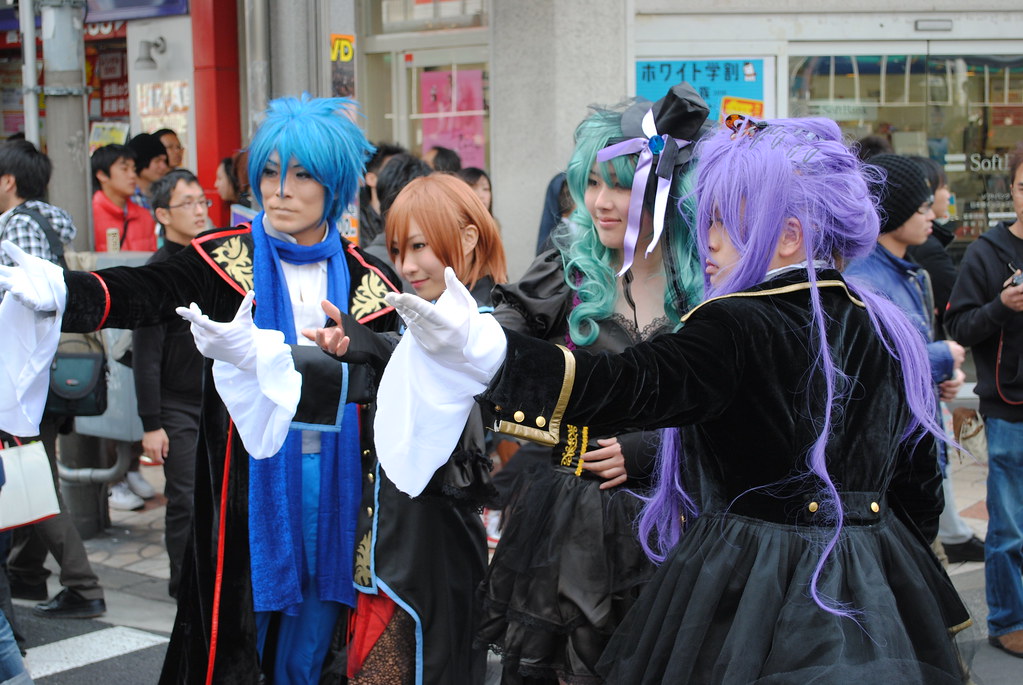
This might not be quite what you imagine when you think of reserved, measured Japan! The surging crowds spoke for themselves, though - hundreds of オタク dressed in specially made costumes, wigs and all. When the hair was too impractical to be real, they just made it themselves!
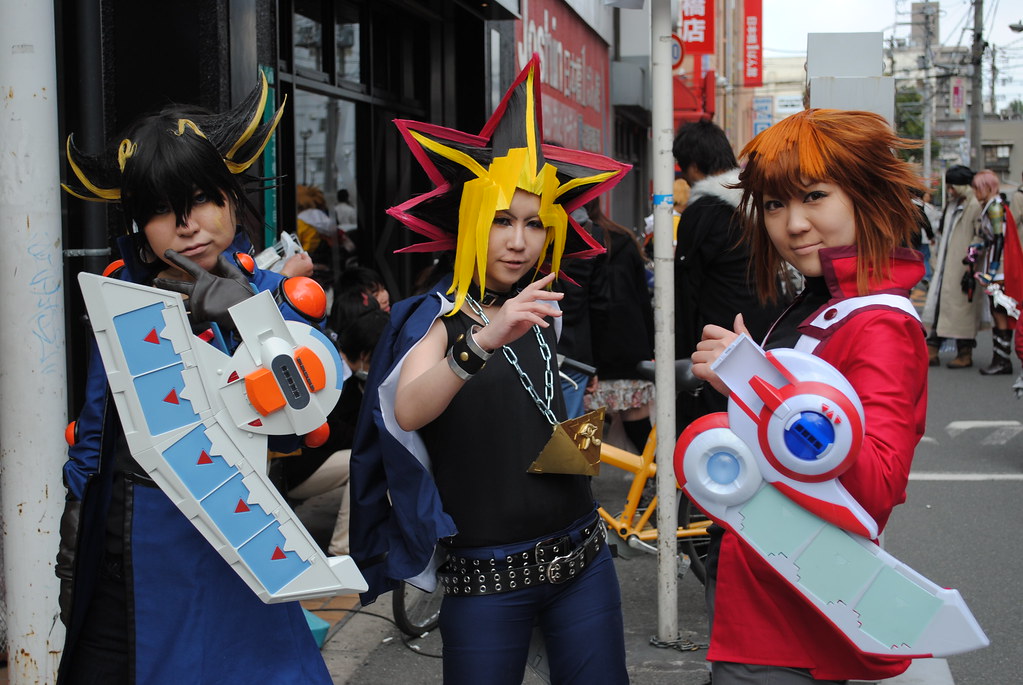
The Yu-Gi-Oh, Pokemon and Dragonball fans were out in force and for every one cosplayer there were ten people there to take photos.
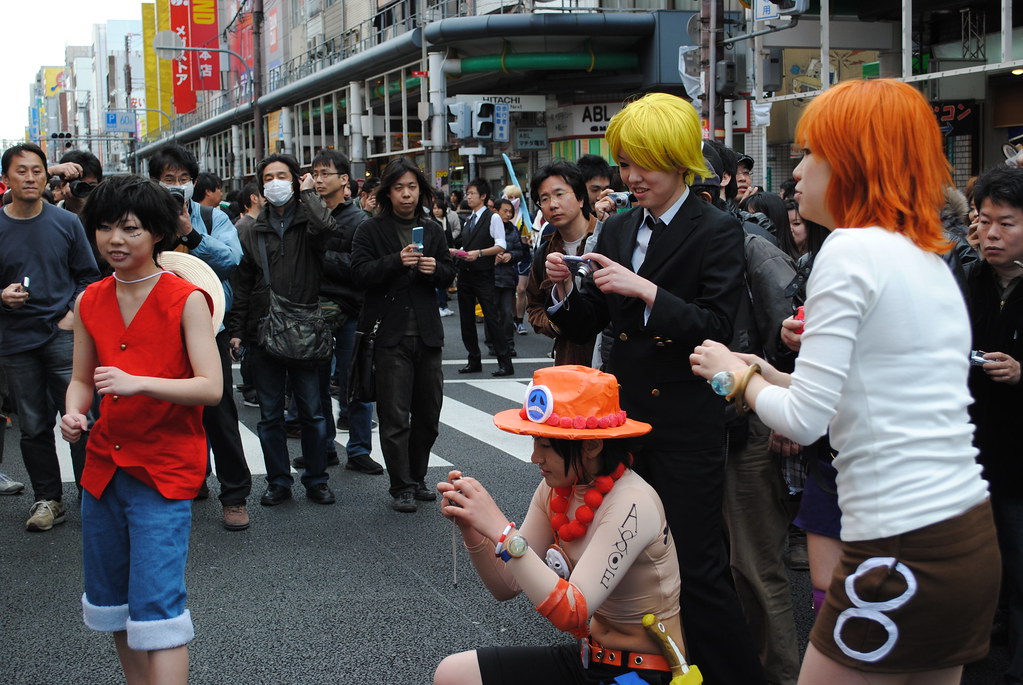
Some of the cosplayers themselves even had the cameras out - these One Piece fans in particular didn't want to let the opportunity for some good photos get away.
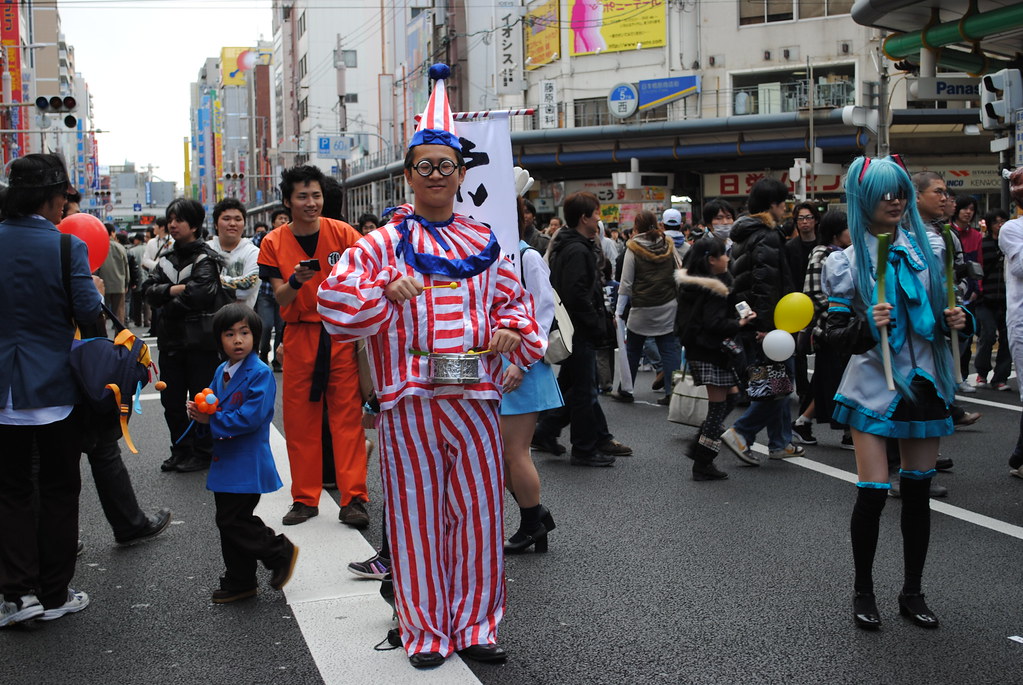
Not everyone was dressed up as modern characters of course, like this cosplayer dressed as 食い倒れ太郎 (くいだおれたろう - kuidaore tarou). He's an old clown-like drummer puppet that stands outside a restaurant in Osaka, who's become a bit of a symbol of the city. His name roughly translates to "eat until you collapse Tarou", which must be something Osaka is renowned for!
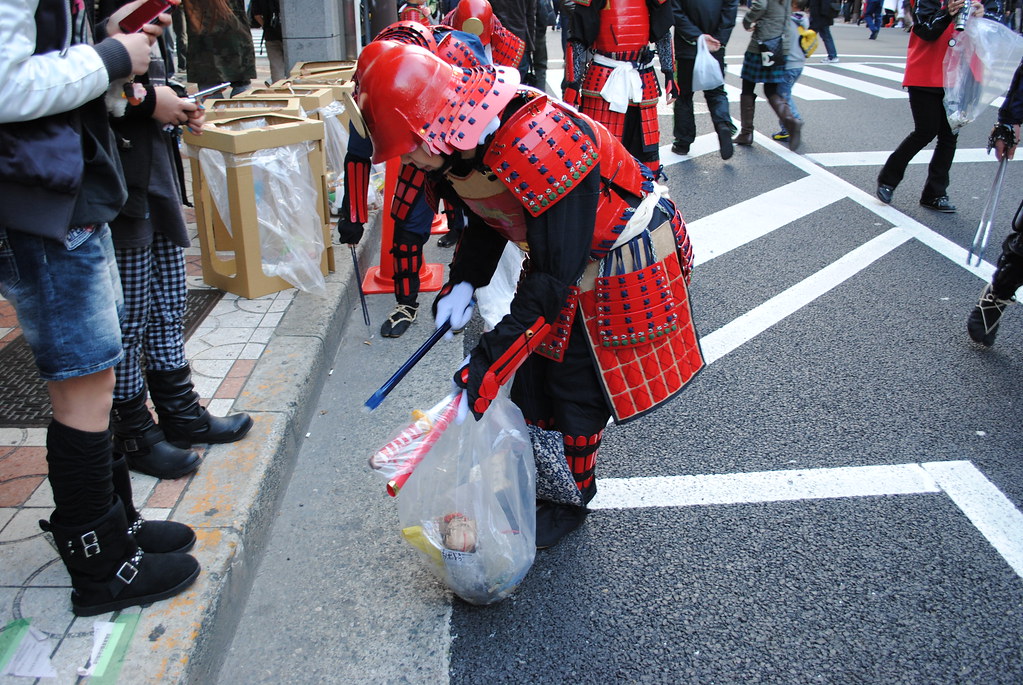
In what would have to be the strangest part of the event, the cleaners then showed up in full costume. I think it's the only time I'll ever see people in samurai costumes picking up rubbish on the street! Welcome to オタクの世界, where even the cleaners enjoy a little コスプレ. I find it amazing that such a large community has sprung up from what must have been humble roots - such is the power of the internet and two-speed Japanese culture. オタク rejoice, and rest assured that whatever kind of マニア you have, there'll be plenty of other マニアック you can share it with. They might even help you make your costume.
Friday, June 11, 2010
~放題 (~ほうだい - ~houdai) - As much as you like!
Reaching into Japan's bag of surprises today produces a little piece of paper that says "放題". It's added to a verb (or occasionally a noun), making the meaning "all you can X" or "X as much as you like". I'm sure most people would think of Japan as a conservative culture; most of what you see is small, delicate servings of food and minimalistic traditions. More and more though, a buffet culture of "放題" seems to be catching on and becoming another facet of the Dr Jekyll and Mr Hyde nature of Japan. The next time you see a picture of a pretty girl in a 着物 (きもの - kimono) eating 寿司 (すし - sushi), bear in mind that it might be her 26th plate.
Friday, May 28, 2010
ユニバーサル・スタジオ・ジャパン - Universal Studios Japan
ユニバーサル・スタジオ・ジャパン (usually shortened to "USJ") is the Japanese import of Universal Studios in the US, located in Hollywood and Florida. Although it doesn't have a massive amount to do with Japan in the traditional sense, it's become a bit of an institution over here so I think it's worth having a look at. It's very easy to get to from 神戸 (こうべ - Kobe) or 大阪 (おおさか - Osaka), you're very likely to go there if you come on a holiday or school trip and it's lots and lots of fun. It's also one of the only chances you'll get to hear Arnold Schwartzeneggar speaking Japanese. If that's not a good Friday topic I don't know what is!
Monday, May 10, 2010
学校の生活その2:文化祭 (がっこうのせいかつその2:ぶんかさい - gakkou no seikatsu sono ni: bunkasai) - School Lifestyle 2: Culture Festival
The 文化祭, usually translated as "Culture Festival" or "School Festival" is a yearly event held at every high school in Japan and is probably the biggest one on the calendar. The teachers and students prepare months in advance and the time leading up to it is one of frenzied activity and anticipation. What's all the fuss about? Let's have a look and find out.
Saturday, March 13, 2010
Mind your Ys and Ws
A couple of interesting Japanese abbrieviations I've noticed:
ワイシャツ (waishatsu - white collared shirt) is often written as Yシャツ.
W is often interpreted as "ダブル" (daburu - double), so you'll often see things like Wチーズバーガー (chi-zu ba-ga-), meaning "double cheeseburger".
Now if you'll excuse me, I'm off to drop my Yシャツ at the drycleaner and pick up a Wチーズピザ (chi-zu piza - cheese pizza) for dinner.
ワイシャツ (waishatsu - white collared shirt) is often written as Yシャツ.
W is often interpreted as "ダブル" (daburu - double), so you'll often see things like Wチーズバーガー (chi-zu ba-ga-), meaning "double cheeseburger".
Now if you'll excuse me, I'm off to drop my Yシャツ at the drycleaner and pick up a Wチーズピザ (chi-zu piza - cheese pizza) for dinner.
Monday, February 22, 2010
裸祭 (はだかまつり - Hadaka matsuri) - The Naked Festival
裸祭 is an intriguing festival that takes place in February every year in 岡山 (おかやま - Okayama), two hours out of Hyogo by local trains or half an hour by 新幹線 (しんかんせん - shinkansen - bullet train). Thousands of men flock to 西大寺 (さいだいじ - Saidaiji - Saidai Temple, a Buddhist one if you remember that post!) for a chance at a cash prize and the promise of health and luck for the rest of the year. Fortunately, the "naked" isn't taken literally - they all wear 褌 (ふんどし - fundoshi - loincloths) and 足袋 (たび - tabi - Japanese split-toe socks). Even so, it makes for a very strange sight... particularly when you remember it's the dead of winter!
Wednesday, February 17, 2010
Worried about your exams? Try an octopus or a Kit Kat!
A couple of little Japanese plays on words for those of you who are a bit superstitious.
Subscribe to:
Posts (Atom)